Open .cr3 files online
To open a .cr3 file in your browser, press Open editor on the RAW photo editor, then choose File > Import Photos and pick your file. The Canon RAW photo joins the editor's library and opens in the develop view with a histogram and exposure, color and tone controls. On 2026-10-29 we opened a public-domain (CC0) 27 MB CR3 from a Canon EOS RP (a standard RAW file, not C-RAW, from raw.pixls.us); it opened within 15 seconds and showed the right picture, coffee, fruit and a salami on a wooden stool, with ISO 100, 50 mm and f/8.0 on the info line. We raised Exposure to +1.00 and exported a full-size JPEG, an 8-bit TIFF and a Rendered photo DNG, all 6240 x 4160. All three read back correctly in macOS tools, and the framing matched the camera's embedded JPEG and macOS's own rendering; our export was brighter, as set. The Raw data DNG option did nothing in our test. The project lists some other CR3 variants as not decoded yet, and we tried one file only. Nothing is uploaded and there is no sign-up.
Best on a desktop browser. This editor has desktop menus and shortcuts.
Can I open it?
To export: in File > Export, type any name in the Folder box first (we used exports), or the export button only shows “Choose an export folder first.” and nothing downloads. The browser version has no folder picker, and the file still goes to your downloads.
| Check | Result | Notes |
|---|---|---|
| Listed by the engine | Listed in docs | Canon CR3 is listed as supported for lossless files, and for C-RAW from some cameras. The project lists other CR3 variants as not decoded yet. In our test the Export dialog lists JPEG, PNG, TIFF, PSD, WebP, AVIF, JPEG XL, DNG and the original file. |
| Opened a .cr3 file | Works | File > Import Photos with a 27 MB CR3 from a Canon EOS RP (a public-domain sample from raw.pixls.us, a standard RAW file rather than C-RAW). It was added to the library as CR3 and opened in the develop view within 15 seconds: coffee, fruit and a salami on a wooden stool showed, with no Preview only notice, and the histogram drew. The info line read ISO 100, 50 mm and f/8.0; its shutter field showed only "1", which we did not investigate. The system file chooser worked, so no drag and drop was needed. |
| Edited it | Works | We typed 1 into Exposure in the Light panel. It read +1.00, the picture got brighter and the histogram moved right. |
| Exported as JPEG | Works | File > Export with Full size ticked (quality 90) wrote a 5.0 MB .jpg. The file command and macOS sips read it as a 6240 x 4160 JPEG with the camera model, the shot time and the software name LightCraft in its metadata. |
| Exported as TIFF | Works | TIFF with 8-bit depth, ZIP compression and Full size gave a 43.8 MB .tif, which sips reads as 6240 x 4160. Its tags show 8-bit RGB with Deflate compression and a color profile; it differs from our JPEG by about 0.2 on a 0 to 255 scale. |
| Exported as DNG (Rendered photo) | Works | The Rendered photo option downloaded a 100.5 MB .dng. sips reads it as a 6240 x 4160 DNG from the same camera, and the JPEG sips makes from it matches our edited JPEG (average difference about 3 on a 0 to 255 scale). Its TIFF tags show DNG version 1.4, 16-bit RGB with the LinearRaw type and Deflate compression, and the software name LightCraft DNG 2. It is a processed picture in a DNG wrapper, not the sensor data. We did not open it in other RAW software. |
| Exported as DNG (Raw data) | Not supported | The Raw data option, described as raw photos as DNG with the edits embedded, did nothing: after OK no download started, and we waited 60 seconds on one attempt. The same option also failed in our earlier DNG, ARW, RAF, RW2, PEF and NEF tests. |
| Compared with other renderings | Works | We put our JPEG next to the camera's embedded JPEG (also 6240 x 4160) and macOS's own rendering of the CR3. The framing matches and the color balance is close. Our export is brighter, which matches the +1.00 we set: average brightness 167 against 128 for both the camera JPEG and macOS. Brightness patterns correlate at 0.99 with the camera JPEG and 0.99 with macOS. We did not judge fine color accuracy beyond that. |
| Other export formats | Not tested yet | The Export dialog also lists PNG, PSD, WebP, AVIF, JPEG XL and Original files. We did not try them. |
| Other CR3 variants and cameras | Not tested yet | We only tried one EOS RP file. C-RAW files, other Canon bodies (R5, R6, R7, M50 and others), and the CR3 variants the project lists as not decoded yet are Not tested yet. |
| Phone screen (390 px wide) | Not tested yet | Not tested for this format. |
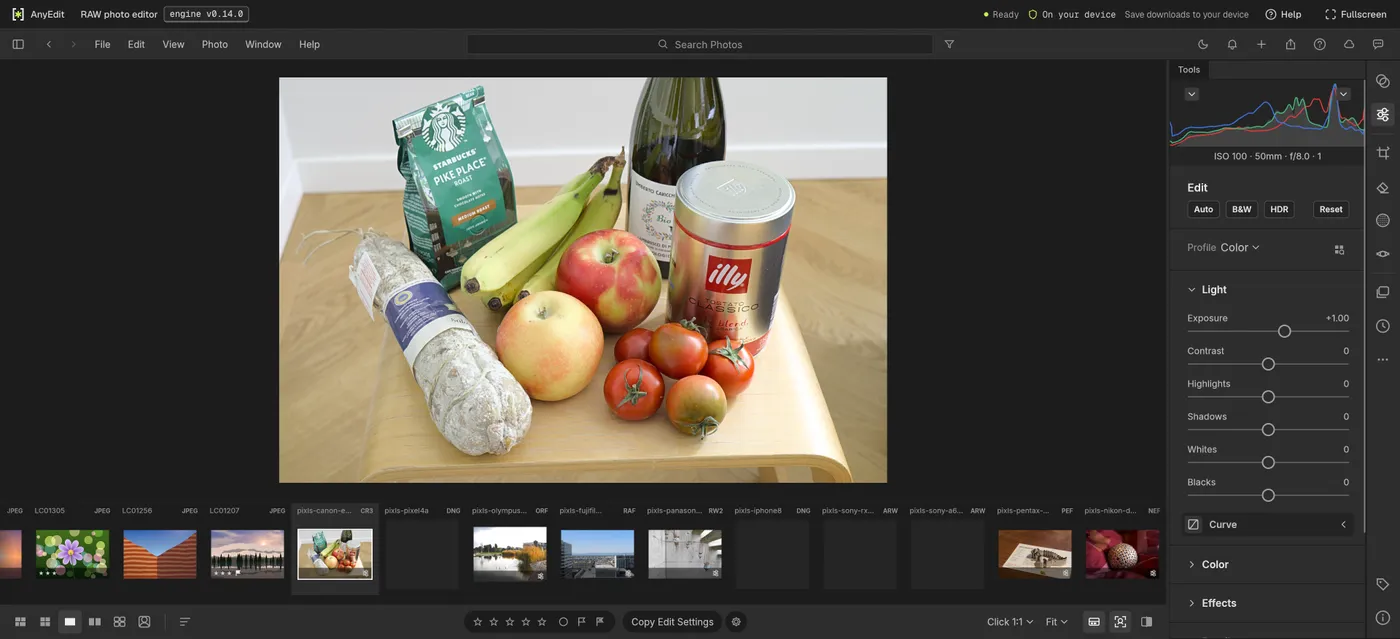
Our test file open in the raw photo editor on anyedit.app, 2026-10-29